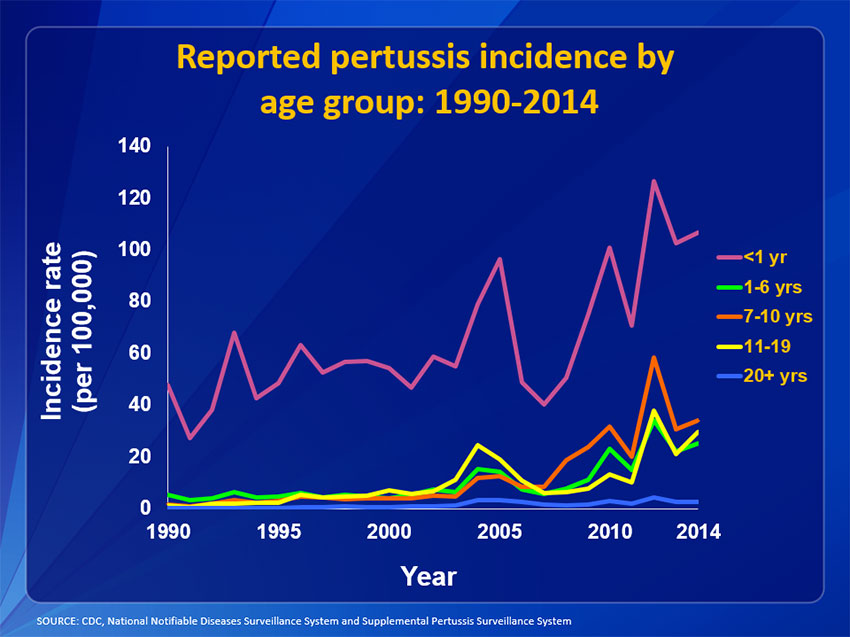
Whooping cough cases in America continue to rise in infants due to both an increasing numbers of parents becoming infected with Pertussis bacteria (whooping cough).  In many cases, adults with cough associate infections are not seen by their physicians as patients just “stick it out” or in other  cases individuals are not screened for the possibility of whooping cough during their doctor visit.  As a result, whooping cough transmission rates to susceptible individuals increase that could ultimately lead to epidemic levels.  In 2013, a Florida school outbreak raised concerns about persistent transmission of whooping cough amongst adequately vaccinated preschoolers.  More study is needed to understand why these preschoolers were susceptible while fully vaccinated. As physicians, we need to take more proactive roles to vaccinate parents against whooping cough with a “booster” and to continue to promote high vaccination rates in infants and toddlers.  As parents, we need to seek medical attention for symptoms of cough that are nagging and protracted to protect our vulnerable babies.

http://wwwnc.cdc.gov/eid/article/22/2/15-0325_article

incidence-graph-age Pertussis


Diagnosed whooping cough cases surge


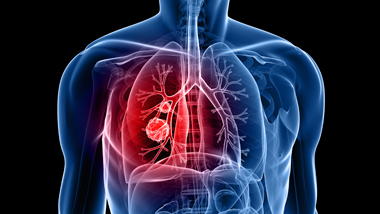
allergic-asthma---380-w-1Time is of the essence, it can happen to your teenager and can take their lives away.  Talk to them about vaping!
CAUTION: What a terrible way to spend your last days on earth gasping for air, oxygen levels deteriorating and huffing and puffing!  It can and will take away your precious teenager.
Recent news releases about this disease is very scary indeed. If you use e-cigs, CAUTION, stop vaping now before its too late!  It appears that this disease may be related to the e-cig toxic chemicals that you are inhaling!
ARTICLEinTOXICOLOGY REPORTS 2 · OCTOBER 2015with8 READS
Exponent, Inc., Irvine, CA, USA
DOI: 10.1016/j.toxrep.2015.10.012
  • 32.89 · Exponent Health and Environmental

    ABSTRACT

Bronchiolitis obliterans (BO) is a rare disease involving concentric bronchiolar fibrosis that develops rapidly following inhalation of certain irritant gases at sufficiently high acute doses. While there are many potential causes of bronchiolar lesions involved in a variety of chronic lung diseases, failure to clearly define the clinical features and pathological characteristics can lead to ambiguous diagnoses. Irritant gases known to cause BO follow a similar pathologic process and time course of disease onset in humans. Studies of inhaled irritant gases known to cause BO (e.g., chlorine, hydrochloric acid, ammonia, nitrogen oxides, sulfur oxides, sulfur or nitrogen mustards, and phosgene) indicate that the time course between causal chemical exposures and development of clinically significant BO disease is typically limited to a few months. The mechanism of toxic action exerted by these irritant gases generally involves widespread and severe injury of the epithelial lining of the bronchioles that leads to acute respiratory symptoms which can include lung edema within days. Repeated exposures to inhaled irritant gases at concentrations insufficient to cause marked respiratory distress or edema may lead to adaptive responses that can reduce or prevent severe bronchiolar fibrotic changes. Risk of BO from irritant gases is driven substantially by toxicokinetics affecting concentrations occurring at the bronchiolar epithelium. Highly soluble irritant gases that cause BO like ammonia generally follow a threshold-dependent cytotoxic mechanism of action that at sufficiently high doses results in severe inflammation of the upper respiratory tract and the bronchiolar epithelium concurrently. This is followed by acute respiratory distress, pulmonary edema, and post inflammatory concentric fibrosis that become clinically obvious within a few months.

Popcorn Lung- Bronchiolitis Obliterans


“Almost all physicians encounter parents who refuse infant vaccines, and about 20% of pediatricians dismiss them, contrary to the 2005 American Academy of Pediatrics guideline, which was reaffirmed in 2013, according to a study published online November 2 in Pediatrics.”

Pediatrics. Published online November 2, 2015

Comment:  Pediatricians and other health care providers should speak to parents or expectant parents about the risk to benefit profile for each of the standard childhood vaccinations, Dtap, Ipv, Hib, HepB, Prevnar, MMR, and Varivax. There should be an opportunity for parents to openly discuss their concerns and apprehension toward vaccines. Pediatricians should provide education using a real life example such as the vaccine, Prevnar that has nearly eliminated cases of Pneumococcal meningitis that until just 20 years ago killed or severely brain devastate even the survivors. Help parents understand that there are just 2 additional vaccines added over the past couple decades.  In addition the combined vaccines given to infant/children are 100 fold more pure today. Use these examples and even consider the use of the vaccine package inserts to show how the risk of the natural infection is much higher than any side effect(s) (rates are included from study patients) from each of the vaccines alone.  Take a look below at what has happened to bacterial meningitis in young children since Prevnar vaccine was introduced around 2000.

From the CDC website:

CDC – Surveillance of Pneumococcal – Chapter 11 – Vaccine Preventable Diseases<!– OLD TITLE BEFORE "070711" Vaccines: Pubs/SurvManual/Pneumococcal Chapter 11 –> //www.google-analytics.com/analytics.js/TemplatePackage/js/B/jquery.js/TemplatePackage/js/B/jquery.watermark.js/TemplatePackage/js/B/common.js/TemplatePackage/js/B/startup.js/TemplatePackage/js/B/blocks-ie.js/TemplatePackage/js/B/video.js/TemplatePackage/js/B/navScripts.js/TemplatePackage/js/B/share.js/TemplatePackage/js/B/govdelivery.js/TemplatePackage/js/B/external.js/TemplatePackage/js/B/plugins.js/TemplatePackage/js/B/syndicateThisPage.js/TemplatePackage/js/B/css-include.js/TemplatePackage/js/B/socialMedia.js
/TemplatePackage/js/B/pngfix.js
/TemplatePackage/js/B/blocks-ie6.js


/TemplatePackage/js/B/jquery.curvycorners.js
/JScript/foresee/foresee-trigger.js/JScript/foresee-variables.js /TemplatePackage/js/B/socialMenu.js//search.usa.gov/javascripts/remote.loader.js/JScript/foresee/foresee-surveydef.js?build=7//search.usa.gov/assets/sayt_loader_libs.js//search.usa.gov/assets/stats.js

The following data includes cases of meningitis, blood infection, or pneumonia

“Following the introduction of PCV7 in 2000, dramatic declines in invasive pneumococcal disease were reported among children aged <5 years as early as 2001. Before introduction of PCV7, rates of PC7-type invasive pneumococcal disease among children in this age were around 80 cases per 100,000 population.  After the introduction of PCV7, rates of disease due to these 7 serotypes dropped dramatically to less than 1 case per 100,000 by 2007 (Figure 1).”

Take a look at pediatricians’ responses to parents who refuse recommended vaccines